
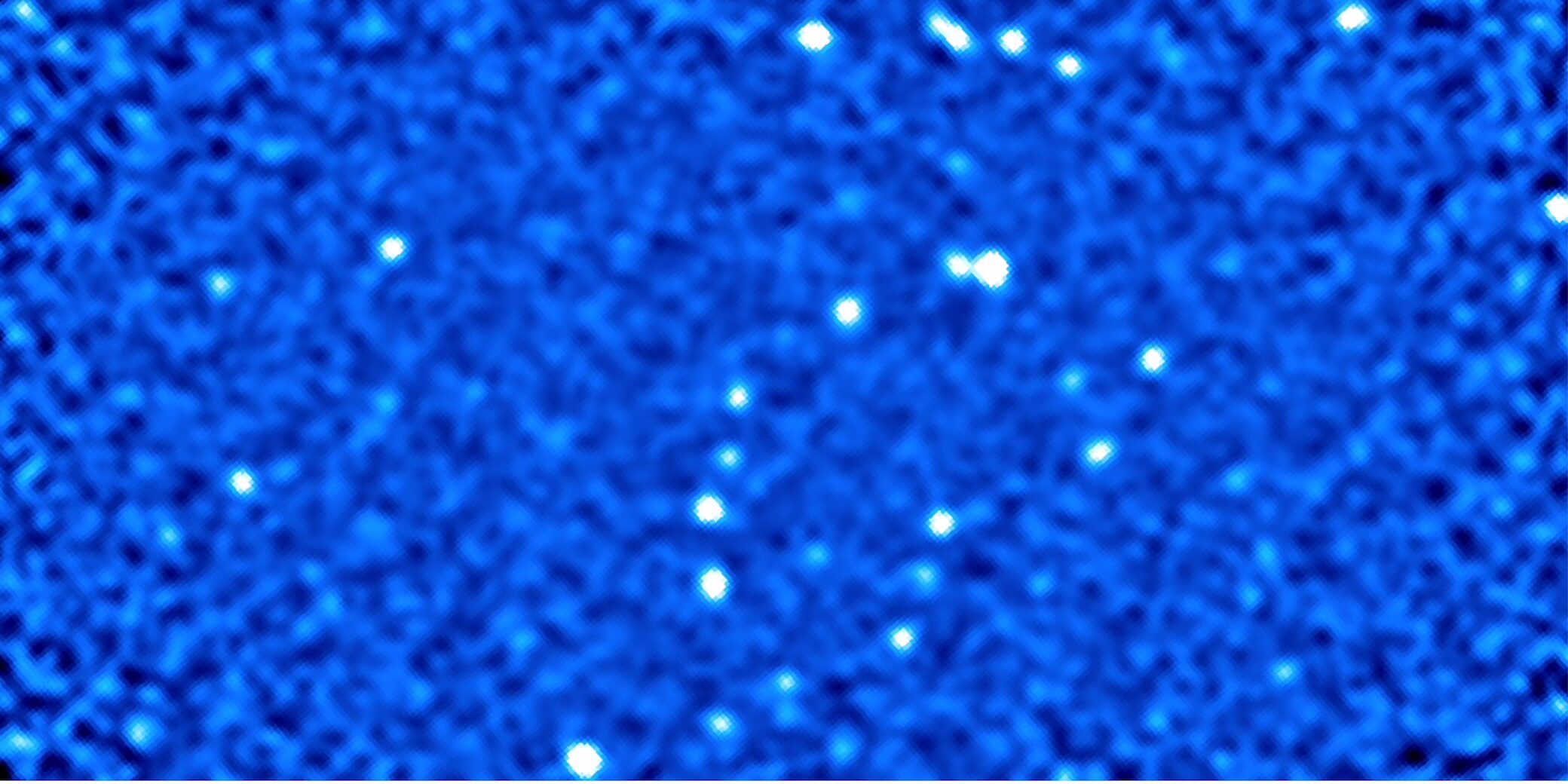
Using the NIKA2 camera on IRAM’s 30-meter telescope, astronomers have achieved a new sensitivity record and discovered a vast cosmic structure comprising massive, dust-rich galaxies dating back to a time when the universe was only one billion years old.
The NIKA2 Cosmological Legacy Survey (N2CLS), conducted using the NIKA2 millimetre camera on IRAM’s 30-metre telescope, has reached a new milestone in exploring the distant universe. For the first time, a survey has reached the limit of confusion at a wavelength of 1.2 mm with a ground-based instrument, achieving an unprecedented level of sensitivity where residual image blur is caused by indistinguishable distant galaxies rather than instrument noise. This technical achievement ushers in a new era in the mapping of very distant galaxies.
This instrumental milestone has led to the discovery of a record number of massive, dusty, intensely star-forming galaxies located more than 12 billion light-years away. These galaxies are located in the GOODS-North Deep Field, a region of the sky that has been extensively studied by the Hubble Space Telescope (HST), but which has never been observed with such precision in the millimetre range.
Some of these objects are forming stars at a dizzying pace — up to a thousand times faster than our own Milky Way — yet they are completely invisible in the deepest images taken by the HST, as they are completely obscured by dust. Several of these galaxies have now been located through additional observations using the NOEMA interferometer and by cross-referencing infrared data from the James Webb Space Telescope (JWST).
Together, these galaxies are part of an enormous structure that is still forming, an embryonic cluster of galaxies stretching over 30 million light-years, at a time when the universe was only one billion years old. This is the first time such a concentration of dusty, ultra-massive galaxies undergoing intense star formation has been detected at this cosmic epoch. These results suggest that, in certain environments in the early Universe, galaxies can form stars extremely efficiently — far more so than current theoretical models predict.
With gas-to-star conversion efficiencies sometimes exceeding 30%, these galaxies are exhausting their gas reservoirs within just a few tens of millions of years. This initiates a rapid transition to the so-called “quiescent phase”.
This spectacular discovery, the result of a collaboration between ground- and space-based observations, sheds light on phenomena that current models still struggle to reproduce. It also highlights the important role of dense environments in forming large structures in the early Universe. It also emphasises the value of combining IRAM and JWST observations to explore the early stages of large cosmological structure formation.
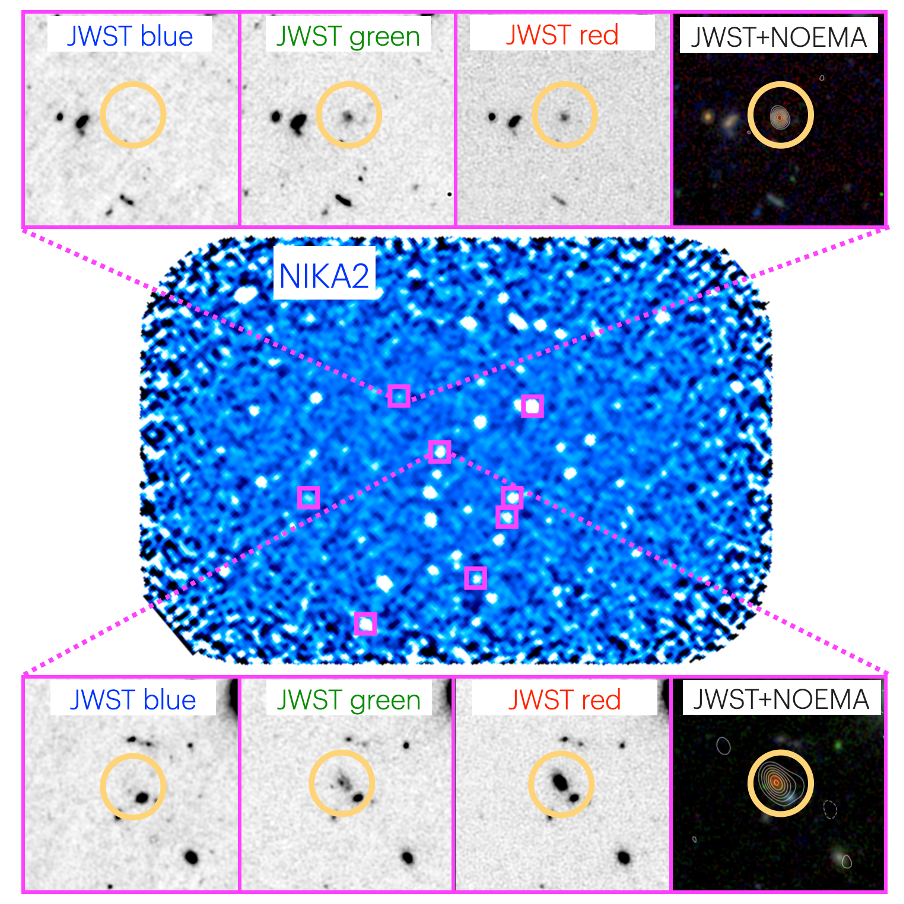
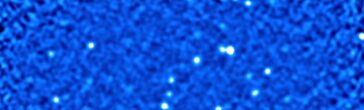
Centre: This is the GOODS-N field, as observed by the NIKA2 camera. Galaxies appear as diffuse white spots. The image has been deliberately overexposed to highlight the faintest galaxies, which also accentuates the edges of the map, where there is more noise due to the observation strategy. Pink squares indicate the eight dusty, massive galaxies belonging to a gigantic cluster in formation more than 12 billion light-years away.
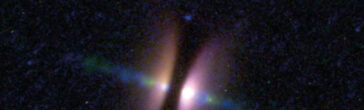
The top and bottom images show two examples of galaxies discovered by N2CLS and observed by the JWST. From right to left, the light changes from blue to red. NIKA2 galaxies are invisible in the blue wavelength. The precise location of these galaxies (within the yellow circle) was determined through additional observations using the NOEMA interferometer and is indicated by the white outlines in the image on the right. The other galaxies shown in the JWST images contain insufficient dust to be visible to NIKA2.
Read more :
Our latest updates
Explore all the latest news from our research and technology groups and never miss out on important upcoming events.