
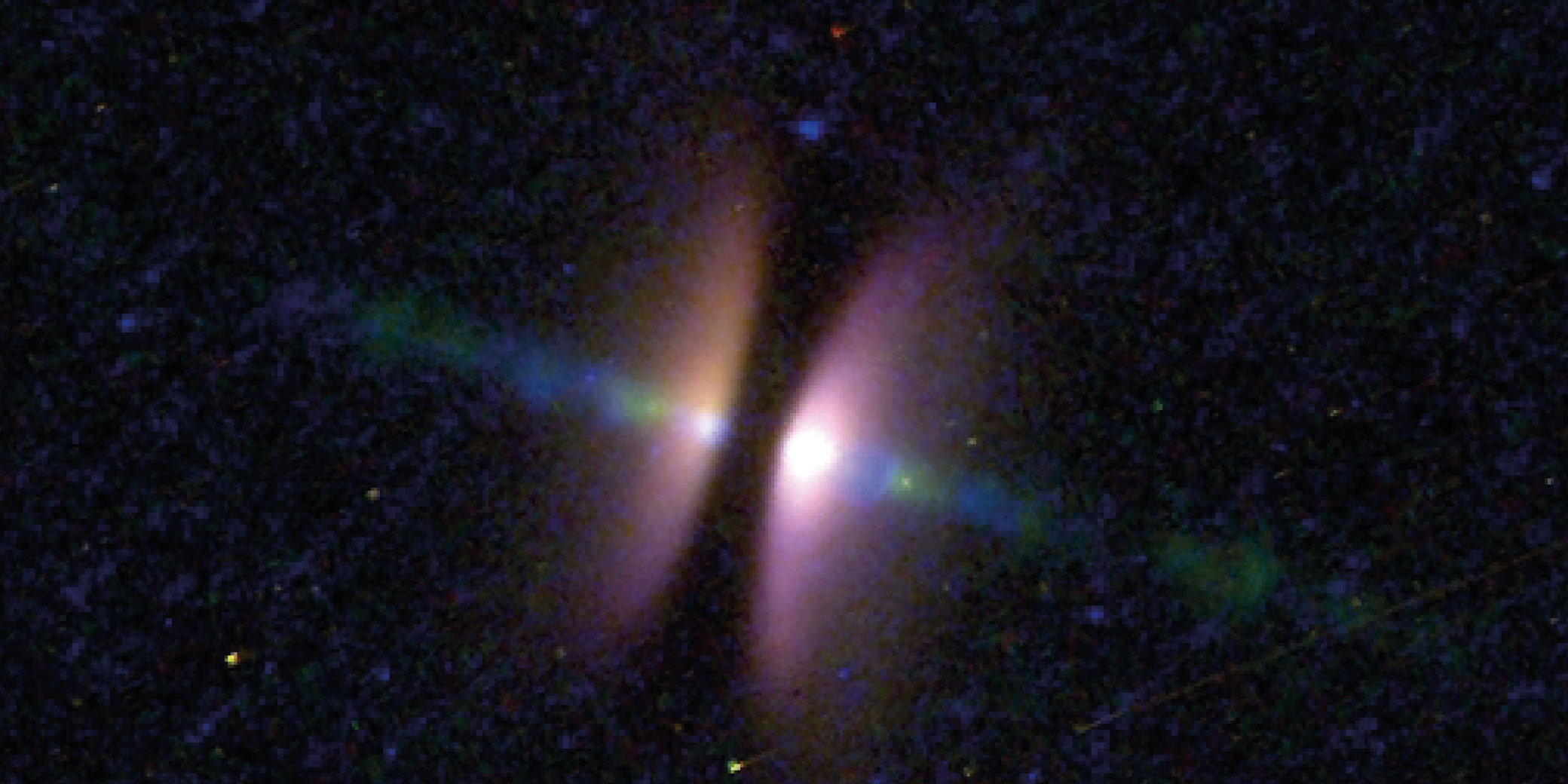
An international team of astronomers has observed a protoplanetary disk seen perfectly edge-on, an orientation that provides a unique opportunity to study how the chemical and physical properties of the disk surrounding the forming star change with height. By combining observations from NOEMA (The Northern Extended Millimetre Array, France) and ALMA (The Atacama Millimeter/submillimeter Array, Chile) the researchers unveiled the vertical molecular stratification within the disk and estimated its vertical temperature structure with unprecedented clarity.
The project was led by scientists from the Observatoire de Bordeaux, working in collaboration with IRAM and a broad consortium of partner institutes across Europe, Asia, and Chile, underscoring a global effort to advance our understanding of the evolution of young star-forming systems.
Protoplanetary disks are found around newly formed stars and are the birthplaces of future planetary systems. While recent observations have revealed their radial structures in great detail, their vertical structure remains much less constrained. Current models suggest a cold disk midplane where molecules freeze out onto dust grains, and a very hot atmosphere above the midplane where molecules are photodissociated by the star’s UV radiation. Between these two regions lies a warm molecular layer. One of the key questions in planet formation concerns the chemical legacy, that is, how much of the chemical complexity present in the disk is inherited by the planets that will eventually form.
To better understand the vertical structure and chemical stratification of protoplanetary disks, the researchers developed a tomographic method to reconstruct the full 3D structure of a star-forming system from observations of disks viewed edge-on, that is, whose midplane is perpendicular to the plane of the sky.
Armed with this new method, the team observed the disk around the young star SSTTau 042021, located in the Taurus constellation at a distance of 160 pc, using the high-spatial-resolution capabilities of NOEMA and ALMA.
These observations were made possible by the recent NOEMA baseline upgrade, which now enables the angular resolution needed to study disk chemistry in detail. “What’s remarkable is that NOEMA is now capable of the kind of science that was only possible with ALMA before,” says Coralie Foucher, the leader of the study.
Using this method, the researchers were able to retrieve the thermal profile of the disk, with a cold midplane and a temperature that rises with height. The abundant carbon monoxide (CO) molecule is found to extend into the disk’s higher layers, while the formyl cation (HCO+) and the less abundant isotopes of CO are more concentrated within the underlying warm molecular layer. By determining which molecules freeze out, evaporate, or are destroyed by the strong UV radiation from the central star, this technique helped the researchers map how key ingredients—such as CO and other compounds—contribute to shaping the evolutionary path toward planet formation.
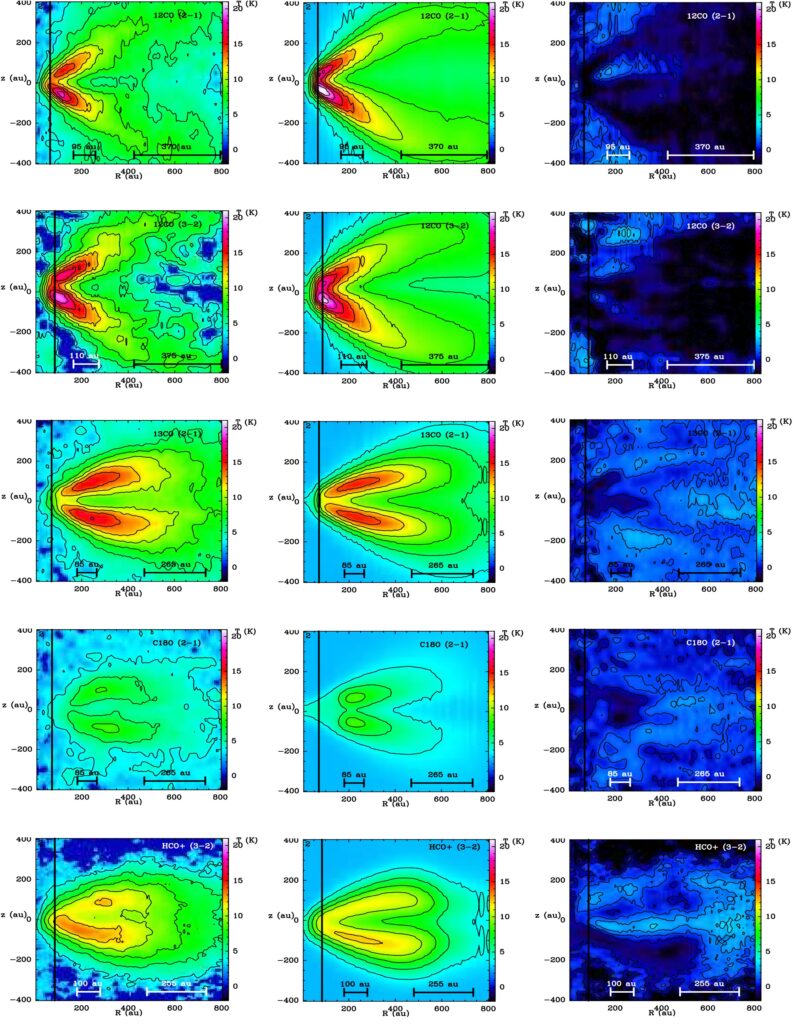
Figure 1: Vertical and radial distributions of species in the edge-on disk SSTTau042021. Left: observed, Middle: modeled, Right: difference between observations and models. From top to bottom: 12CO(2-1), 12CO(3-2), 13CO(2-1), C18O(2-1) and HCO+(3-2)
Media contacts:
Leila Desgeorge
Institut de Radioastronomie Millimétrique
desgeorge@iram.fr
Science contacts:
Coralie Foucher
Laboratoire d’Astrophysique de Bordeaux
coralie.foucher@u-bordeaux.fr
Anne Dutrey
Laboratoire d’Astrophysique de Bordeaux
anne.dutrey@u-bordeaux.fr
Vincent Piétu
Institut de Radioastronomie Millimétrique
pietu@iram.fr
Read the full article
Foucher et al. 2025, A&A, 704, A32
Read the 2 other articles in the same series
Guilloteau et al. 2025, A&A, 700, L5
Dutrey et al. 2025, A&A, 704, A33
Our latest updates
Explore all the latest news from our research and technology groups and never miss out on important upcoming events.