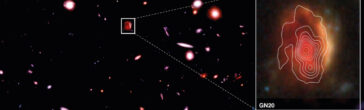

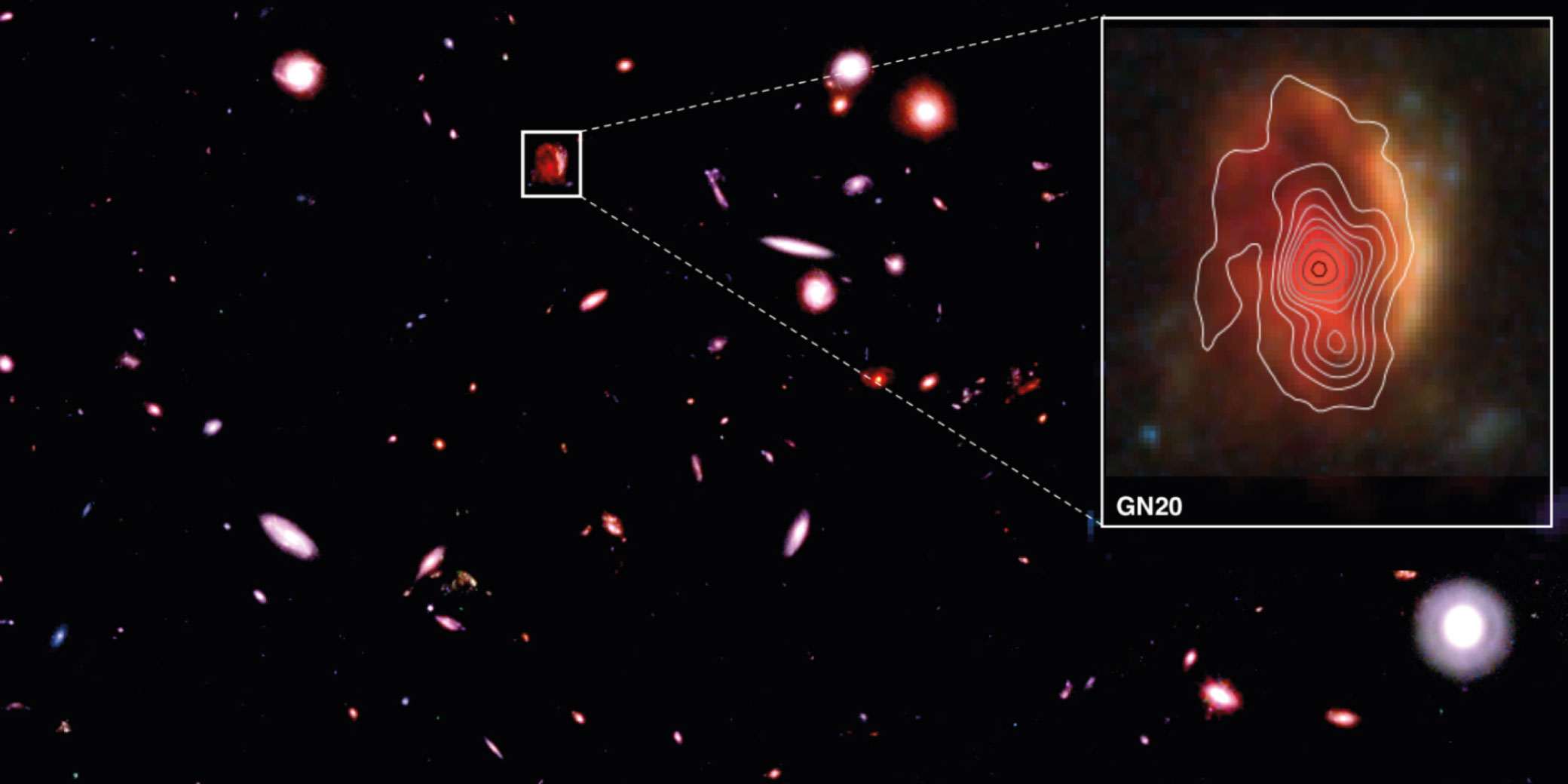
Bars are elongated structures of stars that extend across the central regions of galaxies, such as the Milky Way. They play a critical role in galaxy evolution by driving gas and dust toward galactic centers, fueling intense star formation and the growth of central supermassive black holes. Yet, these structures are not expected to form rapidly in the gas-rich galaxies in the early Universe. Recent high-resolution observations with the NOEMA interferometer have now revealed a bar-like structure in the dust emission of GN20, alongside an enormous reservoir of cold molecular gas. These findings motivated a follow-up study of observations obtained with the James Webb Space Telescope (JWST), which uncovered a stellar bar spatially coincident with the bar-like structure seen in the dust (see Figure 1), challenging classical models of bar formation.
GN20 is a massive and dusty starburst galaxy that is forming new stars at an exceptionally high rate. It is observed at a redshift of z=4.055 or, in other words, when the Universe was only about 1.5 billion years old, compared with its current age of approximately 13.8 billion years. Earlier observations with the IRAM Plateau de Bure Interferometer, followed by higher-resolution NOEMA observations led by Leindert Boogaard (Leiden Observatory, Leiden), Fabian Walter (Max Planck Institute for Astronomy, Heidelberg), and collaborators, provided a detailed view of its dust distribution, revealing the bar-like structure and showing that the dust extends across the galaxy’s stellar and gaseous disk, despite its bright and apparently compact emission. These observations also revealed the galaxy’s exceptionally large molecular gas reservoir. To better understand its physical properties, the team, together with Axel Weiss (Max Planck Institute for Radio Astronomy, Bonn), developed a radiative transfer model describing how radiation from gas and dust at different densities and temperatures is emitted within the galaxy. The model provided an independent estimate of the molecular gas mass, showing that GN20 contains nearly three times as much mass in gas as in stars. The detailed picture of the dust and gas distribution also motivated the team to investigate the galaxy’s stellar morphology. Using its MIRI instrument to peer through GN20’s extreme dust obscuration, JWST revealed the previously hidden stellar bar, associated with intense star formation in the central regions and at the interface between the bar and the surrounding disk.
This discovery is particularly surprising because classical models suggest that large amounts of gas should inhibit or even prevent the formation of stellar bars. Recent simulations, however, show that stellar bars can form rapidly in highly gas-rich galaxies – conditions that were common in the early Universe. The observations therefore suggest that the physics of bar formation at early cosmic times may be very different from that seen in present-day nearby galaxies. As co-author Joss Bland-Hawthorn puts it, “The gas is in charge!” – in contrast to local galaxies, where the stars drive bar formation.
In general, the discovery of the stellar bar has important implications for the evolution of early galaxies. If bars can form efficiently in gas-rich systems, they could provide a mechanism for rapidly transporting gas toward galaxy centers, helping to drive intense star formation and potentially contributing to the subsequent shutting down of star formation of massive galaxies.
A crucial next step is to determine how the gas moves within the bar. New planned NOEMA observations of the molecular-gas kinematics will provide a direct test of the bar’s dynamics and its ability to transport gas toward the galaxy center.
By combining NOEMA observations with JWST and other multiwavelength data, astronomers are progressively revealing the hidden structure and physical conditions of GN20 – providing new insights into how gas-rich galaxies assembled and evolved in the early Universe.
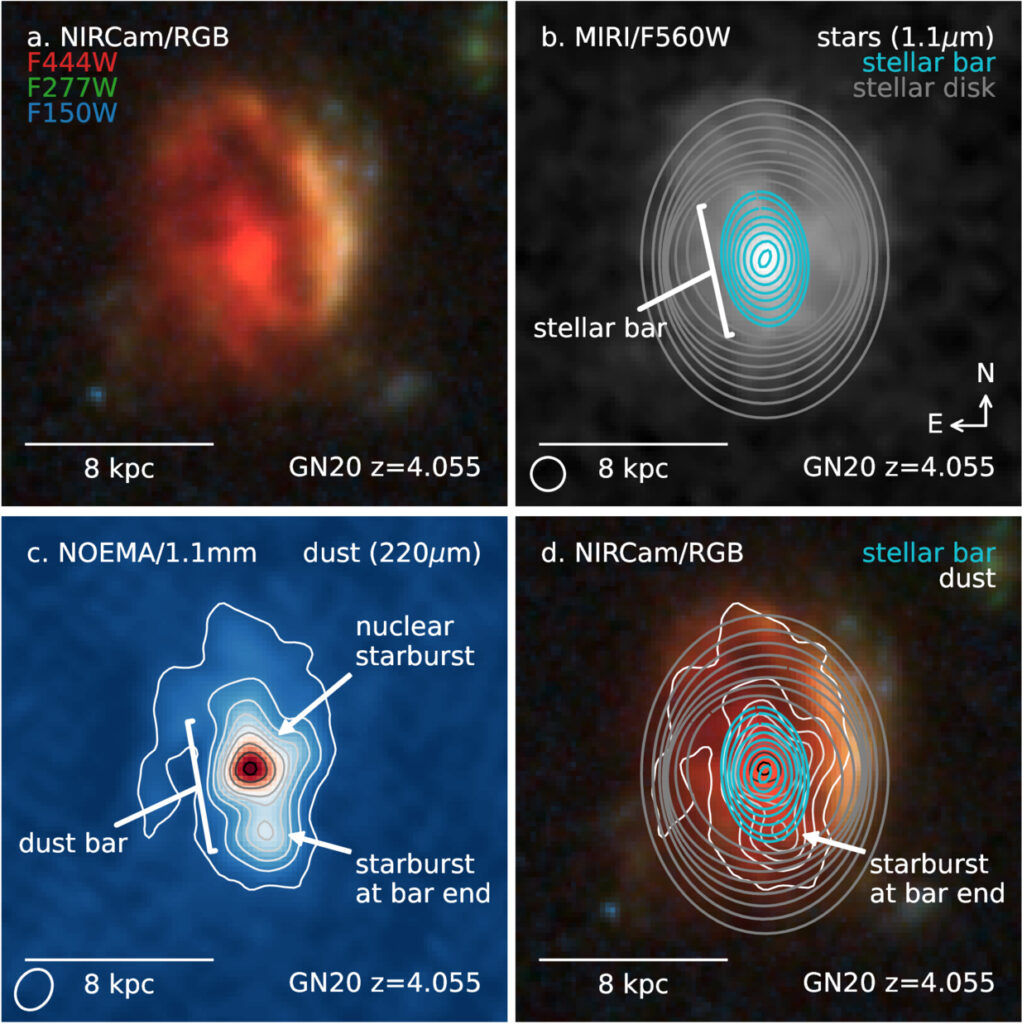
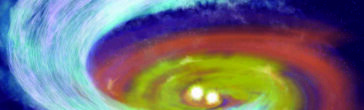
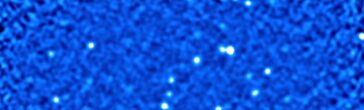
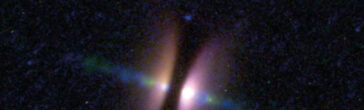
Figure 1: The stellar and dust bars of GN20, a gas-rich galaxy at redshift of z=4.055, seen when the Universe was only about 1.5 billion years old. (a) JWST/NIRCam (Near-Infrared Camera) false-color image of GN20 (b) JWST/MIRI (Mid-Infrared Instrument) reveals a stellar bar in the galaxy traced by the infrared light emitted by the stars. The contours show lines of constant brightness (isophotes), highlighting the bar and disk structure. (c) High-resolution NOEMA observations reveal a bar-like structure in the dust emission, with overall dust extending across the entire stellar disk and tracing regions of intense, dust-obscured star formation (starburst) (L. A. Boogaard et al. 2026a). (d) The stellar and dust bars are closely aligned. Intense star formation is visible in the galaxy’s center, where the bar channels material inward, and where the bar meets the surrounding disk to the south.
Read more:
Boogaard et al. 2026a, ApJ, 996, 19B, 17 pp
Boogaard et al. 2026b, ApJ, 1006, 29, 14 pp
This article was proposed and written by:
Romana GROSSOVA
With contributions from the IRAM Science Highlights Team:
ANEZ-LOPEZ, Nacho
BERTA, Stefano
CIRCOSTA, Chiara
COSENTINO, Giuliana
DESGEORGE, Leila
DU, Kaiyi
EJLALI, Golshan
GROSSOVA, Romana
KRAMER, Carsten
LUO, Gan
NERI, Roberto
ORKISZ, Jan
Our latest updates
Explore all the latest news from our research and technology groups and never miss out on important upcoming events.