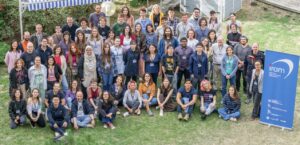
The 13th IRAM Millimeter Interferometry School took place from September 28 to October 3, 2026 at the Hotel Mercure Centre Porte des Alpes in Grenoble, France. Over the course of the week, 53 researchers from 12 countries, including 15% from outside the European Union, participated in the event, reflecting the school’s international reach. The participants included 41 PhD students (77%), 5 postdoctoral researchers (9%), and 7 others (13%), including Master’s students and IRAM personnel, highlighting the school’s primary role in training early-career astronomers.
The program was structured to provide a solid foundation in interferometric techniques, an understanding of the NOEMA interferometer, and an overview of ongoing and future developments of the interferometer. A series of lectures and hands-on training sessions were delivered by IRAM astronomers, with contributions from an external astronomer who provided insights into recent scientific developments across various fields. The tutorials also benefited from the expertise of a former IRAM staff member, who contributed to supervising the practical exercises. The following lectures served as a training opportunity for researchers aiming to work with NOEMA or other millimeter interferometers and to prepare them to effectively process and interpret interferometric data. They are made publicly available.
A dedicated session on proposal preparation focused on making optimal use of the interferometer’s technical capabilities. Participants, grouped according to their scientific interests, worked under the guidance of a tutor to refine their observing proposals for NOEMA, ensuring that they could best translate scientific goals into technically sound observations. This session encouraged productive discussions and knowledge exchange between early-career researchers and IRAM astronomers.
The participants visited the NOEMA observatory on the last day of the school. The visit provided an opportunity to see the interferometer up close, gain a better understanding of its operation, and interact with the observatory staff, who shared their experience and insights into the technical and operational aspects of the facility.
Exploring the millimeter universe – Exploring the role of millimeter facilities in different astrophysical contexts, from galaxies to star formation:
- Introduction to millimeter astronomy (M. Gérin)
Fundamentals of millimeter astronomy – An introduction to the principles and techniques of millimeter interferometry:
- Millimeter interferometry (F. Gueth)
NOEMA – The NOEMA interferometer, how it is operated, the life cycle of a project from its submission to data release:
- NOEMA: What and how (G. Cosentino)
- Lifecycle of a project (C. Circosta)
- <ASTRO introduction and PMS demonstration (J. Boissier)
Calibration – Data calibration techniques at the NOEMA observatory:
- Instrumental and atmospheric online calibration (V. Piétu)
- Offline calibration principles (M. Krips)
Imaging and data analysis – Comprehensive training on imaging techniques, deconvolution, and data analysis methods:
- Imaging and basics of deconvolution 1 (J. Pety)
- Imaging and basics of deconvolution 2 (J. Pety)
- Deconvolution and mosaic (J. Pety)
- Brightness sensitivity (F. Gueth)
- uv-plane analysis (J. Orkisz)
- Self-calibration (R. Neri)
LOC: Edwige Chapillon, Giuliana Cosentino, Leïla Desgeorge, Jaimey Durand, Carsten Kramer, Romane Le Gal, Jean-Yves Michaud
SOC: Felipe Alves, Nacho Añez-López, Arancha Castro-Carrizo, Edwige Chapillon, Chiara Circosta, Giuliana Cosentino, Christian Fischer, Romana Grossova, Carsten Kramer, Romane Le Gal, Ana Lopez-Sepulcre, Gan Luo, Roberto Neri, Jan Orkisz