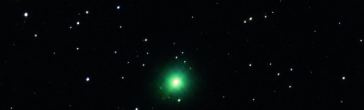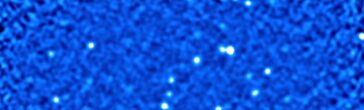

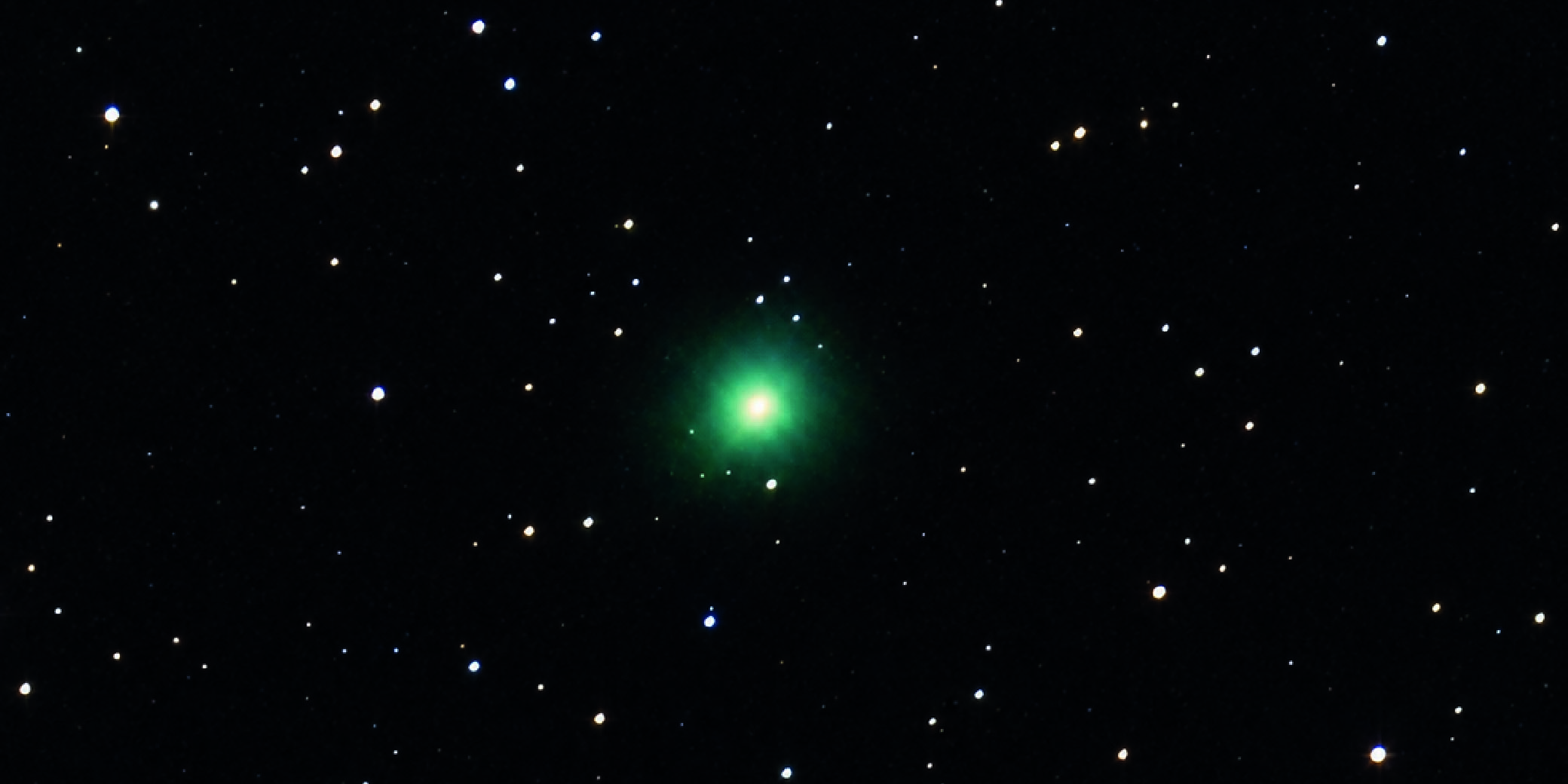
3I/ATLAS is the third interstellar object observed during its journey through the inner Solar System. Using the IRAM 30-meter telescope, a team of astronomers has revealed striking differences between this comet-like object and comets native to our Solar System. The gas surrounding 3I/ATLAS will likely tell how it formed in its original environment. In addition, the gas outflow from the nucleus is significantly slower than expected, suggesting that the coma is populated by complex molecules or icy grains.
Comets serve as fingerprints of planetary system formation. Studying them provides key insights into the conditions under which planets formed and evolved in the early Solar System. They are often referred to as “dirty snowballs,” as they are primarily composed of water ice mixed with other volatile compounds and dust. As they approach the Sun, these ices sublimate, forming an expanding atmosphere around the nucleus (the coma), along with molecular and dust tails extending over large distances. While direct probing of cometary nuclei remains extremely challenging, observations of volatiles in the coma—particularly at millimeter wavelengths—offer valuable information on their composition. Over the past decades, IRAM instruments have played a major role in this field, enabling observations of dozens of comets and the identification of most known cometary molecules, including complex organic species.
The passage of an interstellar, comet-like object through the Solar System provides a unique opportunity to investigate the physical and chemical properties of icy planetesimals formed in other planetary systems. 3I/ATLAS is the third such object identified, following 1I/Oumuamua and 2I/Borisov. Discovered in 2025, it quickly exhibited increasing cometary activity as it approached the Sun making it significantly brighter and more accessible to detailed observations than its predecessors.
A team of cometary scientists led by N. Biver from LIRA, Observatoire de Paris, used the IRAM 30-meter telescope to observe 3I/ATLAS near its perihelion in October 2025. They conducted a spectral inventory of its coma and compared its composition with that of Solar System comets. The large bandwidth of the EMIR receivers enabled the detection of multiple species through several of their emission lines. By combining various faint molecular signatures, the team obtained a clearer picture of the chemicals present and measured the amounts of molecules such as HCN, CH₃CN, CH₃OH, H₂CO, CO, and CS. This allowed them to place upper limits on the abundances of other species, including deuterated molecules and derivatives of sulfur and nitrogen. Although the detected species are commonly observed in Solar System comets, the measured abundances reveal notable differences: 3I/ATLAS is depleted in HCN, and its sulfur-to-carbon ratio is at the lower end—or even below—the range observed in Solar System comets.
Video credit NASA
Another peculiarity emerged during the data analysis: the spectral lines were significantly narrower than expected given the comet’s activity level and heliocentric distance. The line width is directly related to the gas outflow velocity in the coma, i.e., the higher the velocity the wider the spectral line. This suggests that molecules around 3I/ATLAS move more slowly than in typical Solar System comets. The observations support a scenario in which the outflow is driven by heavier molecules—such as CO₂—rather than water, what would explain its lower velocities. Alternatively, water may be released through the sublimation of icy grains in the vicinity of the nucleus.
Future detections of interstellar objects will be essential to determine whether the peculiar composition of 3I/ATLAS is representative or exceptional among extrasolar planetesimals. By comparing the chemical properties of multiple interstellar comets, it may become possible to link their compositions to the diversity of star-forming environments in which they originated, providing a new observational bridge between protoplanetary disks and small bodies.
Read more:
https://ui.adsabs.harvard.edu/abs/2026A%26A…708L..16B/abstract
This article was proposed and written by:
Nacho Anez-LOPEZ
With contributions from the IRAM Science Highlights Team:
ANEZ-LOPEZ, Nacho
BERTA, Stefano
CIRCOSTA, Chiara
COSENTINO, Giuliana
DESGEORGE, Leila
DU, Kaiyi
EJLALI, Golshan
GROSSOVA, Romana
KRAMER, Carsten
LUO, Gan
NERI, Roberto
ORKISZ, Jan
Our latest updates
Explore all the latest news from our research and technology groups and never miss out on important upcoming events.